Gallatin's Median Home Price Describes A House That Doesn't Exist
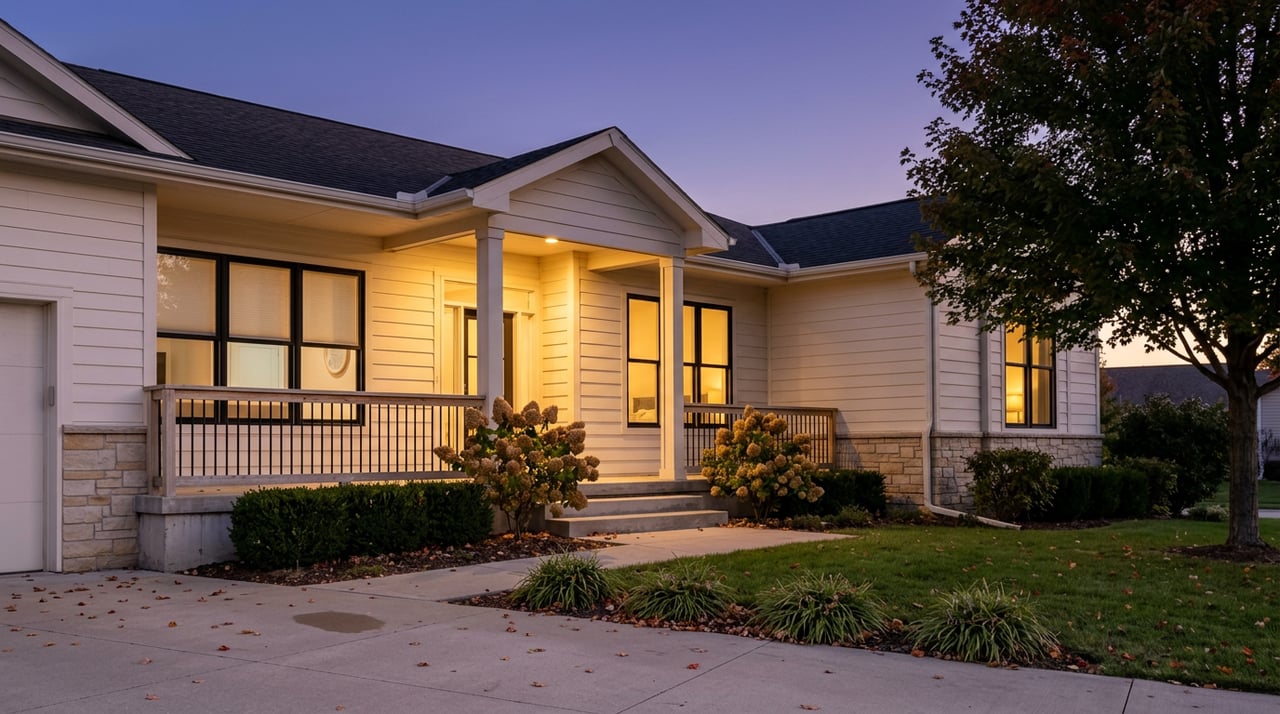
A buyer touring Gallatin on a Saturday can see three completely different housing markets before lunch. Ten in the morning: a 1920s bungalow two blocks off the courthouse square, no HOA, hardwood floors that have outlived four owners. Noon: a 2025-built single-family home in Cumberland Landing with a $85-a-month HOA and a floor plan that didn't exist when the buyer started their search. Two o'clock: a lakefront listing in Fairvue Plantation with a boat slip and a price tag seven figures higher than anything they saw that morning.
All three homes sit inside the same city limits. All three would get folded into the same headline number when someone Googles "Gallatin home prices." And that number, the one showing up on portals and in market reports right now, sits at $429,990 for the roughly 1,483 homes that closed there over the trailing 12 months, an increase of about 4 percent from the prior year's $413,342. That median sold at exactly 100 percent of list price, which sounds like a market in perfect balance.
It isn't a balance. It's an average of three markets that never actually bid against each other.
Here's the mechanical problem. A median only works as a decision-making tool when the units being averaged are reasonably similar. Gallatin's are not. The trailing-year data shows individual closings ranging from $75,000 up to $6.375 million within the same rolling 12 months. That's not noise around a center point. That's three distinct product categories stacked into one zip code, each with its own supply pipeline, its own buyer pool, and its own pricing logic.
| Tier | What's actually there | Typical closed range |
|---|---|---|
| Historic in-town core | Pre-1950 cottages, bungalows, farmhouses near the courthouse square | roughly $106,000 to $400,000, median near $259,950 |
| New-construction corridor | Nexus, Cumberland Landing, Windsong, Oxford Station and similar subdivisions built 2023 to 2026 | roughly $265,000 to $635,000 depending on product type |
| Old Hickory Lake waterfront and golf | Fairvue Plantation, Foxland Harbor, and private lakefront lots | roughly $500,000 to $6.375 million, waterfront median near $1.18 million |
A buyer who anchors to $429,990 and starts shopping the historic core will think every listing near the square is a screaming deal. A buyer who anchors to that same number and starts shopping Fairvue will assume they're priced out of the entire city. Neither read is correct, because neither buyer is actually shopping in "Gallatin." They're shopping in one of three sub-markets that happen to share a mailing address.
The historic core isn't undervalued. It's structurally capped. Recent sales of pre-1950 homes split into two distinct groups: 24 of 28 closings were in-town cottages and small farmhouses on lots under half an acre, closing between $106,000 and $400,000 with a median of $259,950. The other four sat on ten or more acres and closed between $525,000 and $1.75 million, an entirely different property type wearing the same construction date.
Streets like College, Boyers, Winchester, Park, and Morton run through this part of town, close enough to the Gallatin Commercial Historic District and the Palace Theater to be genuinely walkable, which is rare anywhere else in Sumner County. But there's no new supply coming. Nobody is subdividing a lot on Winchester Street to build another 1920s bungalow. The inventory that exists is the inventory that will ever exist, and that scarcity keeps this tier a fixed size while the rest of the city keeps growing around it.
The subdivision corridor is where the volume lives, and volume is exactly why it drags the citywide median toward its own center rather than the historic core's or the lake's. Nexus North and Nexus South, built primarily by D.R. Horton and David Weekley Homes, combined for roughly 193 closed sales at a median of $409,990, with townhomes clustering from $294,900 to $340,000 and single-family product in Nexus North running $370,000 to $500,000. That single corridor alone outproduces the entire historic core many times over in raw transaction count, which is exactly why the citywide median sits closer to new-construction pricing than to anything downtown.
The newer the phase, the more the HOA structure varies in ways that matter to a monthly payment. Cumberland Landing, the newest entrant with homes built in 2025 and 2026, closed 49 sales at a $355,000 median with an HOA of just $85 a month. Woods Crossing, also brand new, closed larger homes averaging over 2,150 square feet at a $517,514 median, carrying a remarkably low $30-a-month HOA. Compare that to sections of Nexus, where fees run from $55 to $411 a month depending on whether the home is a single-family lot or a gated 55-plus villa. Two homes at similar price points, three streets apart, can carry HOA obligations that differ by hundreds of dollars a month, and that gap rarely shows up until a buyer is deep into a specific listing.
For buyers who want an older, non-HOA alternative in this price range, Elk Acres, off Highway 109, closed 19 sales at a $390,000 median on all-brick or partial-brick homes built between 1997 and 2017. It's one of the few pockets that split the difference between new-construction pricing and historic-core character.
School zoning adds another wrinkle inside this same tier. Kennesaw Farms, The Paddock at Kennesaw Farms, Kensington Downs, and McCain's Station all feed Station Camp schools, and those zoned neighborhoods have consistently commanded a premium over comparable homes zoned for Gallatin City schools. The Paddock closed 25 sales at a $482,689 median, meaningfully above several Gallatin City zone subdivisions offering similar square footage. The city's planning department maintains an ongoing list of approved residential developments, including projects like Kensington Downs and The Knoll at Fairvue, for buyers who want to see what's still moving through entitlement before it hits the closed-sales data.
Waterfront pricing on Old Hickory Lake is where the citywide median completely stops applying. Thirty-four waterfront homes closed in Gallatin over the trailing year at a median of $1,177,500, up from $995,000 the year before, an 18.3 percent jump in a segment where the citywide median rose about 4 percent over the same stretch. That's not the same market accelerating. That's a fixed-supply category behaving like one.
Old Hickory Lake's shoreline doesn't expand. Every waterfront lot in Gallatin already exists, and the only new inventory comes from teardown-rebuilds or resales, which is part of why thin transaction volume produces sharp price swings that a larger, more liquid market would absorb.
Inside that 34-home sample, 19 closings included a private dock or boat slip and 11 did not. The homes without a dock started around $500,000 and topped out near $2 million. That single feature, whether the Army Corps of Engineers had already issued a dock permit for that specific parcel, explained a meaningful share of the spread between a $500,000 close and one well north of that.
Even within a single named community, the numbers can disagree. One report puts Foxland Harbor's overall median near $860,000. Another, looking only at two recent phases inside that same community, shows a $1,150,000 to $2.3 million range. Both are accurate. They're just counting different sections and different months in a market where five or six closings a year is a normal sample size.
That's the honest caveat for anyone shopping the lake tier specifically: a neighborhood name is not a price. In a segment this thin, the phase and the closing date matter as much as the subdivision does.
Fairvue Plantation shows the same internal spread at an even wider scale. Ten closed sales in the past year ranged from $762,500 to $6.375 million, a median of $1.23 million sitting in the middle of a $5.6 million gap between the lowest and highest close. A lakefront lot inside Fairvue and an interior lot inside the same gated community are not comparable properties, even though both would show up under the same community name in a quick search.
None of this is an argument against Gallatin. It's an argument against treating one citywide figure as if it applies to a specific address. A seller in Cumberland Landing pricing off the $429,990 citywide median is ignoring that their own subdivision closed at $355,000. A buyer comparing a Fairvue listing to "the Gallatin market" is comparing it to a number built mostly from new-construction townhomes that have nothing to do with lakefront pricing.
The subdivision is generating steady demand from job growth along the Highway 109 corridor, anchored by employers like the Meta data center and Servpro's headquarters, along with continued growth in the historic downtown's restaurant and retail base. That demand is real. It just isn't evenly distributed across the three tiers described above, and pricing a home, or setting an offer, against the wrong tier's comps is where most surprises in this market start.
If you're weighing Gallatin against other options in Sumner County, or trying to figure out which of these three markets actually fits your budget and your must-haves, The McGiboney Team can pull the subdivision-level and phase-level comps that a citywide median will never show you.
Does the median home price in Gallatin include waterfront sales? Yes. The citywide figures cited above include everything from in-town cottages to Old Hickory Lake estates in the same rolling 12-month dataset, which is exactly why the median lands in the middle of three very different markets rather than describing any one of them accurately.
Why do two listings in the same subdivision have such different HOA fees? New-construction communities in Gallatin often phase their amenities and fee structures over time. Nexus, for example, shows HOA fees ranging from $55 to $411 a month depending on whether a home is a single-family lot, a townhome, or part of a gated active-adult section. Always confirm the current fee for the exact address, not the community average.
Is a home without a dock still considered waterfront? It can be, but the price gap is real. In the most recent 12-month sample, no-dock waterfront homes started around $500,000 while dock-equipped homes pulled the segment's median well above $1.1 million. A property's dock status should be confirmed with current Army Corps of Engineers permitting records before it factors into an offer.

With a passion for real estate and a deep connection to the communities they serve, The McGiboney Team is your trusted partner in navigating the ever-changing real estate market. Let them help you turn your real estate dreams into reality. Contact them today to discuss all your real estate needs!
Get in Touch With Our Team to Learn More
530 W Main St Hendersonville, TN 37075